Novelists who hope to have their manuscripts published often seek out feedback from so-called beta readers: thoughtful and detail-oriented readers of fiction who are familiar with (and, even better, fans of) the novelist’s genre. More often than not, beta readers are writers themselves, which can give them deeper insights into the narrative moves that novels make to appeal to readers.
Novelists might seek chapter-by-chapter feedback from beta readers as they work through a first draft. Or, like me, they might wait until they have a complete first draft on hand. In either case, the comments from beta readers can alert novelists to issues with character development, plot, and pacing, and to any other problems that could turn off prospective agents or publishers, and eventually readers. For this reason, I’ll never consider submitting a manuscript to publishers without first getting comments from beta readers.
So how did this habit of mine get started? And how have I found beta readers? Also, how do I make the most of their feedback? Read on for the details.
My Introduction to Beta Readers: A Fiction-Writing Course in College
Many years ago, while an undergraduate at Ohio State University, I took my first fiction-writing course, taught by the wonderful Robert Canzoneri, who was the original director of OSU’s creative writing program. As part of the course, fellow students and I “workshopped” the short stories we wrote for the class. In other words, we shared (spoken) comments on other students’ stories in a group setting, and silently listened and made notes when it was time for our own stories to be critiqued.
Although workshops have long been a feature of creative writing programs, I was completely unfamiliar with them when I enrolled in Dr. Canzoneri’s course. So I listened carefully as he advised the class on strategies for commenting on others’ writing. In short, he encouraged us to be honest, specific, and direct (but never cruel) about places where a manuscript confused us or posed other hurdles to our understanding or enjoyment of a story. He also suggested that we point out what was working well in a manuscript. He modeled this approach through his own comments on our stories, which were detailed, constructive, and in my experience always more inspiring than deflating. To put all this another way, in Dr. Canzoneri’s course, my classmates and I were not just writers in training but also beta readers in training.
(As an aside, a few years after I graduated from Ohio State, I wrote to Dr. Canzoneri to thank him for his advice and inspiration, which I thought of often as I struggled through drafts of short stories and attempted to write a novel. He responded with a typewritten letter of encouragement, which I still hold onto. I’ll never forget his kindness and support.)
After taking Dr. Canzoneri’s course, I understood that if I planned to continue writing fiction, which I did, I’d also need to continue to get thoughtful critiques of it. That brings me to the next chapter of my writing life.
My Search for Good Beta Readers
After graduating from college, I wrote as much fiction as I could when I wasn’t working, and shortly after moving to Boston, I enrolled in a fiction workshop at the Boston Center for Adult Education, hoping to find willing and able critique partners.
The workshop’s instructor was excellent, but I soon learned a critical lesson that wasn’t in the course description and that underscored a feeling that I began to have when I was taking Dr. Canzoneri’s course: that not everyone in a writing workshop was going to be a good match for me and vice versa. At times, participants’ goals, desires, and practices just weren’t aligned.
To give just a couple of examples from my BCAE experience, some students appeared to want a support group instead of a workshop and seemed resistant to anything other than positive comments on their work. (Support groups have their place, of course, but they weren’t what I was looking for.) Other student critics seemed to want to push fellow writers out of the driver’s seat of their stories, suggesting changes to their manuscripts that felt overly prescriptive or out of touch with the kind of tale the writer was trying to tell. To rephrase this rather crudely, when presented with an apple, they saw the potential for an orange, and pushed for it.
But in that group of about fifteen students, four of us seemed to get each other and what we were trying to achieve with our work. When I listened to their comments on my works-in-progress, I was wowed by how they’d identified issues that I’d somehow been blind to, and what they said rang true to me and to what felt right for the story. In time, the chemistry among us became clear to all concerned, and as the course wrapped up, we decided to break off into our own writers’ group, essentially becoming beta readers for each other’s stories and novels-in-progress.
This decision sparked a collaboration that went on for more than twenty years, seeing me through the drafts of three novels. Whenever a member of the writers’ group had to depart due to a move or another life change, we’d bring on a new writer whom one of us had recommended. And now and then, we’d add yet another writer or two, growing to as many as six members. Although the writers’ group eventually petered out, I still keep in touch with many of its members, and some of us still beta read for each other.
Whenever I’m searching for new beta readers, I look for folks who, like my old writers’ group friends, are talented and thoughtful fiction writers, and who are willing to be frank about any shortcomings they see in my work. Always, I’m happy to return the favor.
How I Make the Most of Beta-Reader Feedback
For each novel I’ve written, I’ve asked at least four beta readers to comment on the first draft. Once I’ve heard from all of them, I read through their comments and let them stew in my mind for a while, often not returning to them (and my manuscript) for a week or more. Then, I begin to write down ideas for the revision based on these comments and my own reflections. Usually, I incorporate these ideas into an outline of the book that indicates where the various revisions might be made.
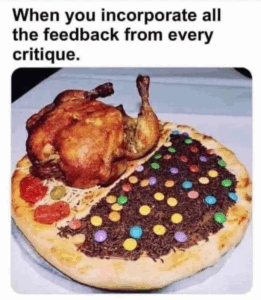 If two or more beta readers point out the same problem with a manuscript, it’s usually pretty clear that I have to address this issue in some way. At other times, though, beta readers’ suggestions might point in different directions, making the revision strategy less clear. For example, one reader might argue that a certain secondary character should be cut. Another reader might really like this character and suggest that they be fleshed out. This conundrum brings me to a social-media meme about the impossibility of incorporating every suggestion from beta readers (see the nearby art). Of course, it’s all on the writer to figure out how to proceed. Quite often when facing such revision conundrums, I’ll eventually think of a solution that seems to have come from out of the blue but feels just right. Often, this happens when I’m away from the computer, out for a walk or run.
Beyond Beta Readers: Working with Book Editors
Just briefly, I want to mention the important role of book editors, who usually step in at a later stage of a book’s pre-publication journey to offer feedback (typically, after a book has been accepted by a publisher). Most writers–perhaps especially those who’ve worked with beta readers–hope that at this later stage, their book won’t require major overhauls and that the editor will focus mainly on grammar, syntax, and other sentence-level issues. Alas, this is not always the case, and a good editor will sometimes identify deeper-level issues for the writer to address. (I discuss this more-in-depth level of editing and the benefits of the writer-editor collaboration in a separate blog post.)